Features
From a folder of frames to a candidate you can check by eye
- 01
Calibration and alignment
Darks, flats, dark flats, hot pixels; color cameras — a 2×2 superpixel. Frames are registered on stars with distortion, a meridian flip and several nights taken into account. Before the search you can flip through them as in a blink comparator and drop cloudy ones.
- 02
Search
Bright objects — on single frames. Faint ones — with synthetic tracking: trying velocities and stacking frames with a shift. Comets — both fast ones and slow ones whose coma moves less than its own size during the night.
- 03
Coordinates and identification
Plate solving with ASTAP, the built-in solver on the ASTAP star database (no internet) or Gaia DR3; refinement to fractions of an arcsecond. Known objects in the field are requested from JPL — if the search missed one, the frames are stacked along its prediction.
- 04
Result
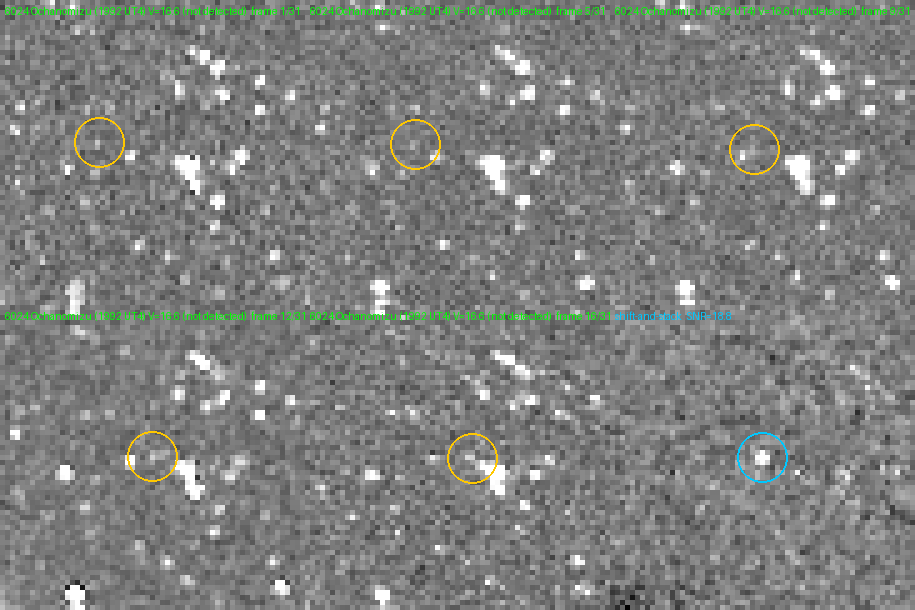
A field overview with labelled objects, CSV tables with coordinates and an animation of each candidate: a cut-out from every frame and the stack along the motion.
Capabilities
Everything you need to hunt small bodies
Faint asteroids
Synthetic tracking finds objects 1–2 magnitudes fainter than what is visible on a single frame.
Comets
Fast ones — from differences between parts of the night, slow ones — by the shift of the nucleus. Around a found nucleus the program checks for a coma.
Several nights
Tracks of one object on different nights are linked into one object; a meridian flip and separate sessions are no problem.
Precise astrometry
ASTAP, and if it fails — the built-in solvers on the ASTAP database and Gaia DR3. Polynomial distortion correction.
JPL identification
Known asteroids and comets in the field are labelled; those missed by the search are checked by stacking frames along the prediction.
Variable stars
Experimental: search for variables in the field and light curves checked against the VSX catalog.
The whole field in one picture
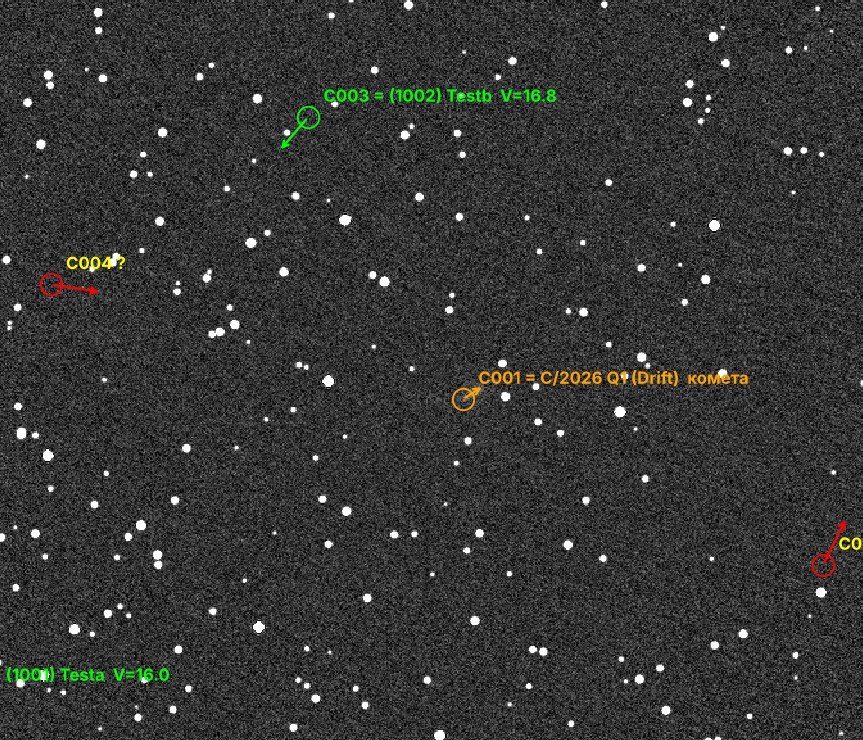
Identified known objects are labelled in green, new candidates in yellow-red, comets in orange, and known objects the search did not find — with a blue dashed line. An arrow shows the motion during the night.
Next to it — CSV tables: candidates, the position on every frame with RA/Dec and the known objects of the field.